
Faculty News
Antawan I. Byrd
Assistant Professor of Art History
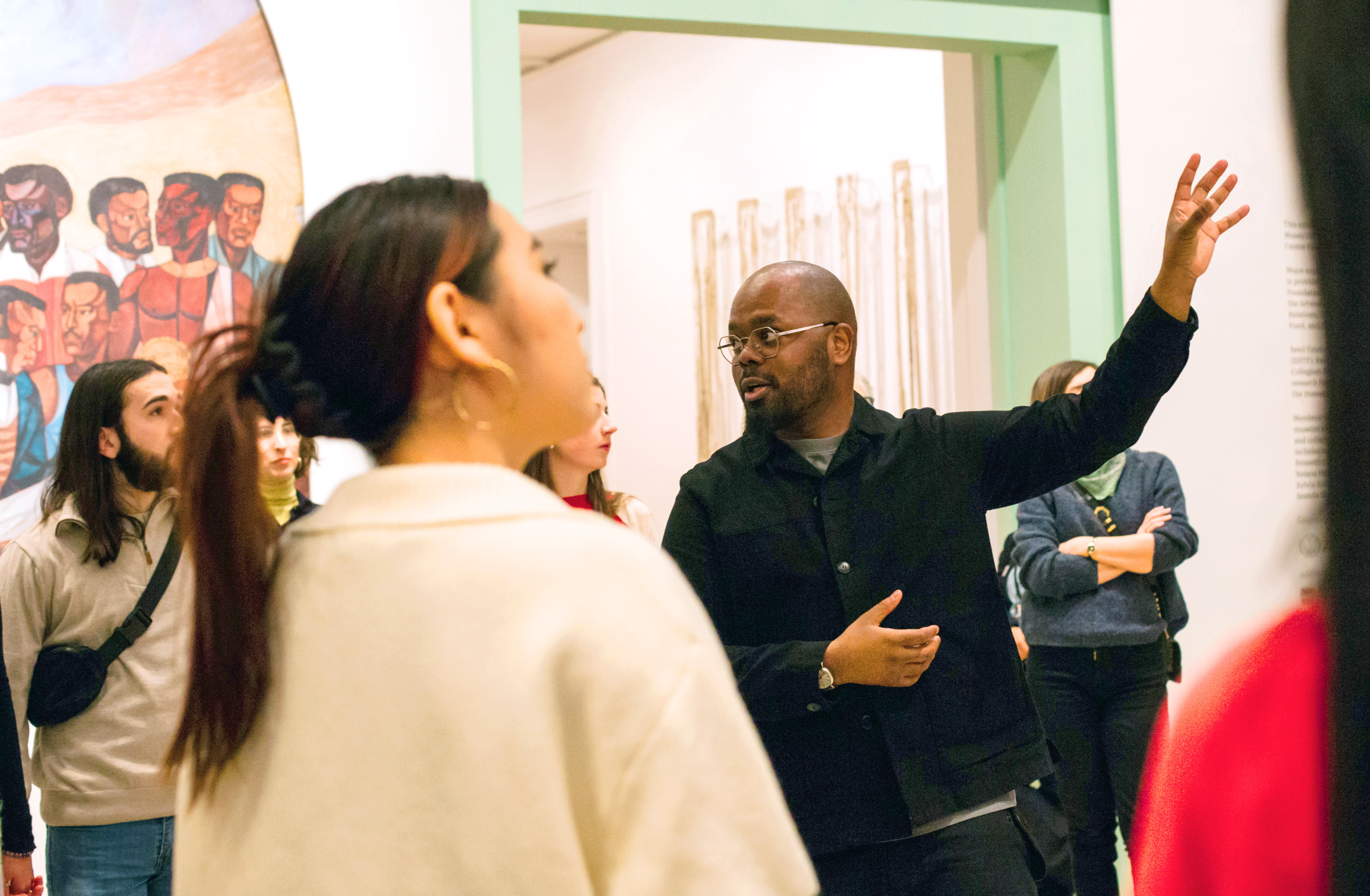
It was a full and rewarding year for Antawan I. Byrd, whose 2024–2025 activities spanned curatorial and research projects, teaching and advising, and a range of service engagements. In December 2024, he celebrated the opening of Project a Black Planet: The Art and Culture of Panafrica at the Art Institute of Chicago. The accompanying catalogue, which Byrd co-edited and to which he contributed a major essay, represents an unprecedented study of Pan-Africanism’s influence on art and culture. As part of the show’s robust public programming, Byrd co-organized Panafrica Days, a weeklong series of symposia, performances, film screenings, and exhibition openings presented in collaboration with cultural institutions across greater Chicago, including Northwestern’s Black Arts Consortium and Herskovits Library. In addition to teaching undergraduate courses on Black Portraiture and Contemporary African Art, Byrd co-taught (with Adom Getachew) a new graduate seminar on Pan-Africanism. He enjoyed supervising undergraduate Raya Bryant Young’s senior thesis on the 1969 exhibition Harlem on My Mind and serving on the graduate qualifying exam committees for David Jones and Uche Okpa-Iroha. This year, he published a short essay on the links between Pan-Africanism and the Global Majority in the catalogue accompanying Prospect.6 New Orleans. His year also included talks at Columbia College, New York University’s Institute of Fine Arts, the Logan Center for the Arts, Yale University, and the Arts Council of the African Studies Association’s triennial conference. Byrd served on the juries of several grantmakers, including Artadia, 3Arts, and Northwestern’s Kaplan Institute for the Humanities artist-in-residence program. Byrd spent the bulk of his summer in France and the UK for continued research and writing on his book manuscript, Being Seen Listening: Art, Pan-Africanism, and the Sound Politics of the Sixties, and traveled to Stockholm to deliver a lecture on this project at the Moderna Museet in August.
Alicia Caticha
Assistant Professor of Art History

This spring, Caticha's research was inspired by multiple visits to the Art Institute of Chicago's exhibit, Ancient Roman Sculpture from the Torlonia Collection (2024). This collection—which had never before traveled to the United States—featured ancient Roman sculptures heavily restored during the eighteenth-century. It was an irresistibly rich case study for understanding the construction of the white, classical marble ideal.
During the 2024–25 academic year, Caticha taught a new graduate seminar on theories of Materiality, a Freshman writing seminar titled “Empires of Fashion: from Marie Antoinette to Meghan Markle,” a course on Rococo Art, and the Art History Research Methods course required of all Art History majors. (Caticha loves getting to meet and work with all our fantastic majors!) In Fall of 2024, Caticha published the article “Material Masquerade: Porcelain, Sugar, and Race on the Eighteenth-Century French Dining Table” in the journal Art History. The article, which traces the interrelated histories of French soft-paste porcelain and ephemeral sugar sculpture, serves as an introduction to her larger book project, “Sculpting Whiteness in Eighteenth-Century France: Sugar, Porcelain, Marble.” Caticha will continue work on this manuscript next year as an Alice Kaplan Institute for the Humanities faculty fellow (2025–26).
Thadeus Dowad
Crown Junior Chair in Middle East Studies & Assistant Professor of Art History
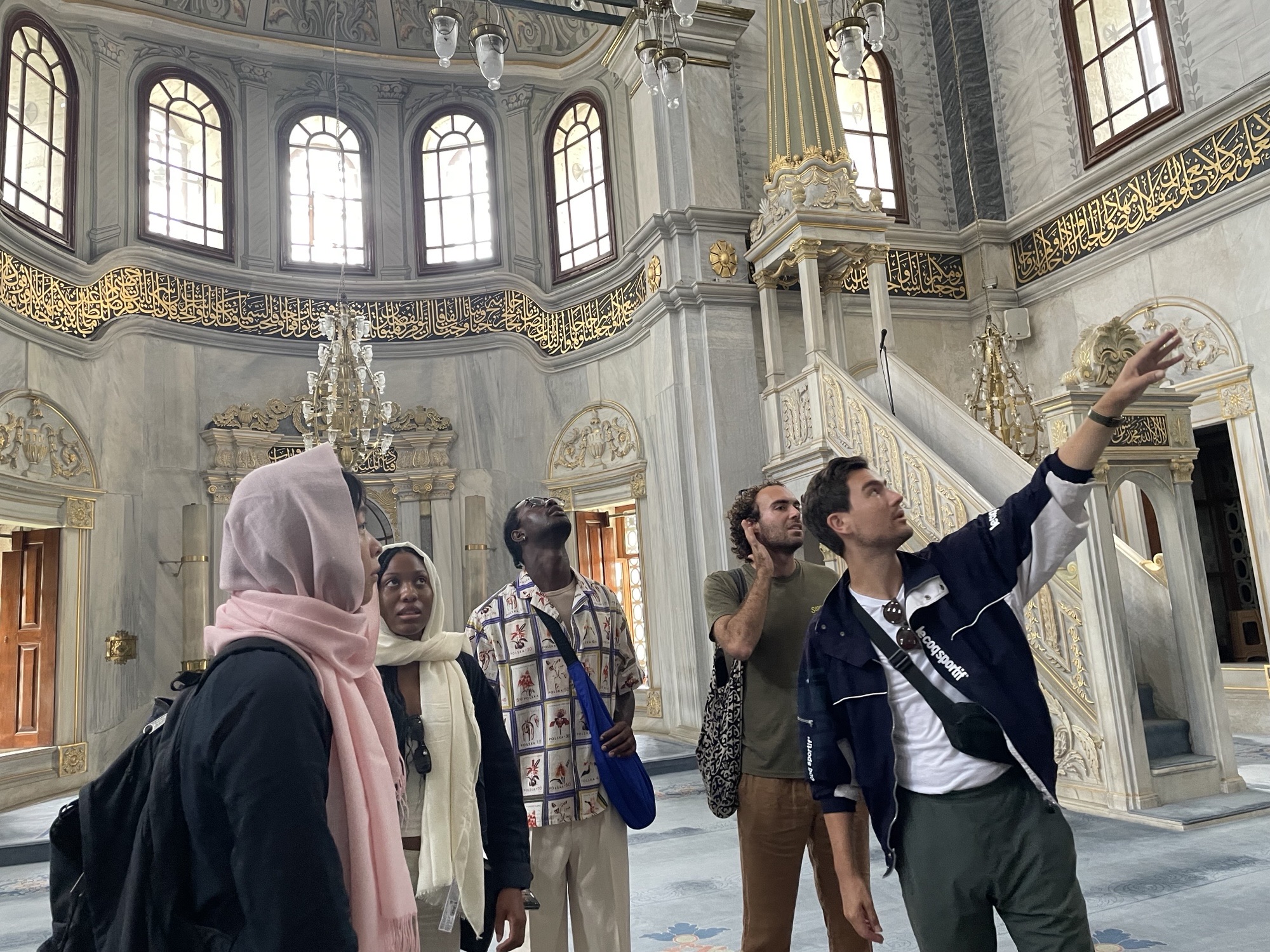
Dowad with PhD students Jingyi Dai, Malaika Shuck, Nathanaël Lapierre, and Griffin Berlin at the Nusretiye Mosque in Istanbul.
In the run-up to the academic year, Dowad led the rising second-year graduate students on a two-week trip to Istanbul as part of the department’s annual summer seminar. Their jam-packed itinerary included visits to historical sites across the city, from Byzantine monasteries and Ottoman palaces to modern art museums and galleries. They also met with local scholars, curators, and artists who shed light on the city’s past and present through collaborative seminars, roundtable discussions, and artist studio visits. On his return to Chicago, Dowad was appointed the Crown Junior Chair in Middle East Studies and joined the core faculty of Northwestern's Middle East & North African Studies Program. In November, Dowad delivered a lecture related to his ongoing book project at Bryn Mawr College's Colloquium in Visual Culture (at the invitation of 2019 Ph.D. alum, C.C. McKee). In April, Dowad shared sections of his book project with the Newberry Library's Eighteenth-Century Seminar, with Professor Emerita Holly Clayson as his generous respondent. The following month, the exhibition The First Homosexuals: The Birth of a New Identity, 1869-1939, to which Dowad served as a consultant, opened at Chicago’s Wrightwood 659 to rave reviews. His essay tracing the impact of sexological discourse on the art of the Middle East and North Africa from the 18th century to World War II appeared in the exhibition's catalogue.
Jesús Escobar
Professor of Art History; Charles E. and Emma H. Morrison Professor in the Humanities
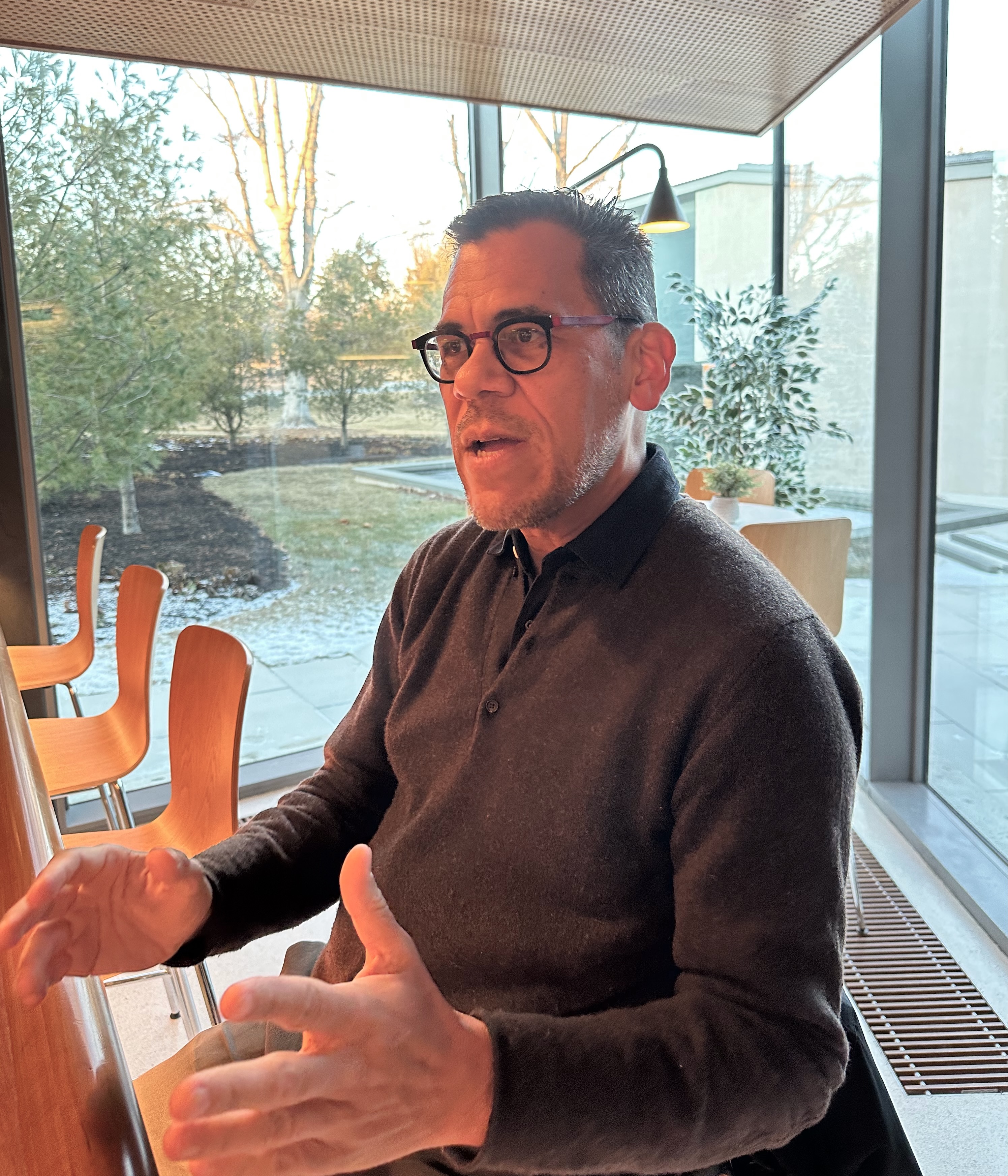
Professor Escobar deep in conversation with fellow historians at Rubie’s, the bar at IAS Princeton. Photo: Adam Jasienski.
This past year, Jesús Escobar was a Member of the School of Historical Studies at the Institute for Advanced Study, Princeton, where he advanced his book project “Americans Abroad in the Seventeenth Century: People, Buildings, and the Space of Empire.” In February, Arquitectura y monarquía en Madrid, 1620–1700, a Spanish-language edition of his 2022 book, was published in Madrid by the Centro de Estudios Europa Hispánica. Escobar also published an essay for a volume about governmental palaces across the Spanish Habsburg world that accompanied an exhibition at the Palazzo Reale in Naples, Italy, and delivered a paper in the Princeton-Mellon Forum on the Built Environment, “Interconnected Lives, Networked Places: New Narratives about Architecture in the Spanish Empire.” This year included the appearance of the eleventh book in the series [Buildings, Landscapes, and Societies] edited by Escobar. A study of late Ottoman architecture in Greece and Albania, it was the fourth of four BLS titles published since 2023 about architecture and urbanism in the Islamic world. Escobar continues to serve on the Board of Advisors for the Center for Advanced Study in the Visual Arts and as President of the National Committee for the History of Art. In recognition of his scholarship, teaching, and service, Escobar was named Charles E. and Emma H. Morrison Professor in the Humanities in September. An investiture ceremony will be held during the 2025–26 academic year.
Bihter Esener
Assistant Professor of Islamic Art and Medieval Mediterranean
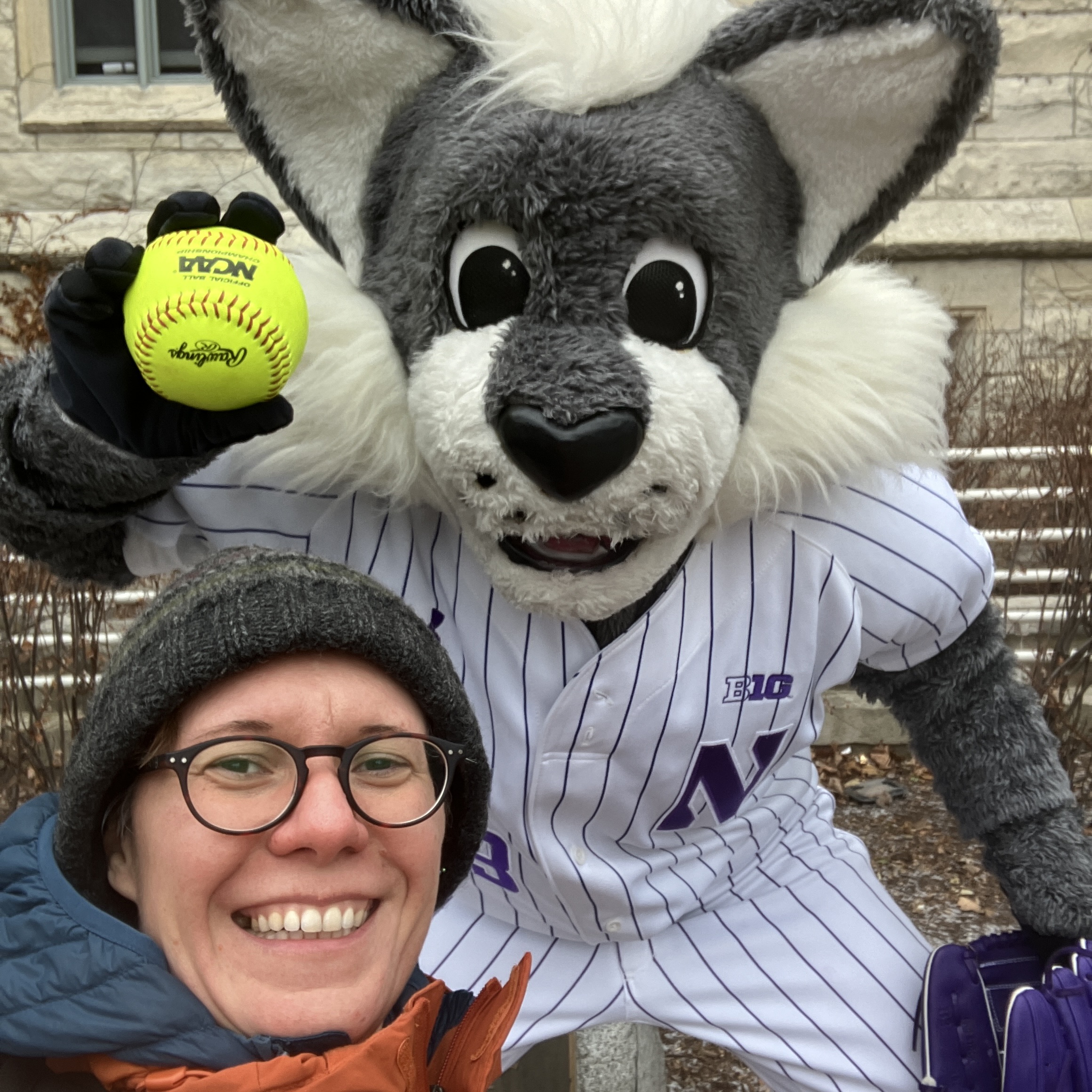
Bihter Esener with Willie the Wildcat before the baseball season at Northwestern University, February 11, 2025.
Bihter Esener was excited to join the department as Assistant Professor of Islamic Art and Medieval Mediterranean and spent the 2024–25 academic year as College Fellow—a postdoctoral fellowship through the Weinberg College of Arts and Sciences. In the Winter quarter, Esener taught two courses: “Art and Architecture of the Medieval Mediterranean World” and “First-Year Writing Seminar on Medieval Sports and Art,” during which she enjoyed meeting and teaching Northwestern students. She was selected by the Northwestern Teaching and Learning Technologies (TLT) to join the inaugural faculty cohort for Generative AI, a professional development program aimed at increasing digital literacy in generative artificial intelligence, co-sponsored by the Provost’s Advisory Committee. Esener was invited as the keynote speaker for the 2025 Pre-Modern Global Studies Celebration, focusing on technology, gaming, and AI at Eastern Illinois University, to deliver a lecture on “From Parchments to Pixels: Exploring and Playing the Premodern World in the Ludic Age.” She also organized a pedagogy workshop on Teaching Islamic Art and Visual Culture with Khamseen: Islamic Art History Online at the University of Michigan. During the Kaplan Institute’s Third Thursday meetings, Esener gave a flash talk on digital pedagogy, drawing from her experience as a founding member of Khamseen. Esener contributed to Materialities of Disease Across the Medieval World (ARC Humanities Press, 2025) with an essay titled “Solomon’s Jinns and the Art of Healing,” which was published this past summer.
Ann C. Gunter
Bertha and Max Dressler Professor in the Humanities
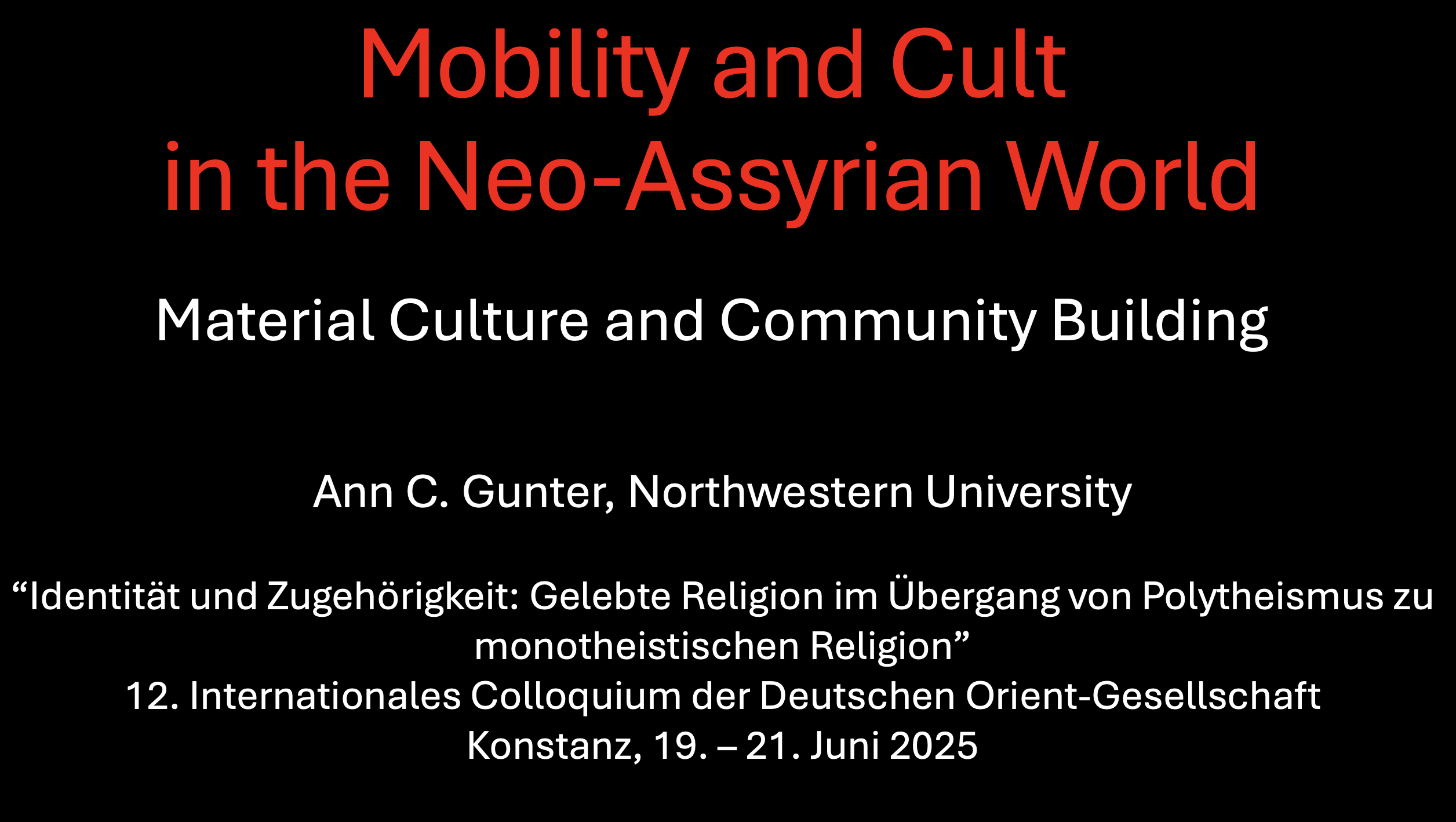
In September 2024 Ann Gunter began a year-long research leave, the first in nearly ten years. Her primary aim was to make significant progress on the manuscript of a book in a new series launched by Cambridge University Press within its Cambridge Elements program, a predominantly digital platform aimed at a broad readership that includes advanced students as well as specialists and allows a maximum of 30,000 words and 30 illustrations. Provisionally titled Artistic Styles and Visual Narratives in the Iron Age Mediterranean, the book adopts a pan-Mediterranean perspective, exploring the transfer of local and regional styles to new locations as a consequence of Phoenician and Greek migrations and overseas settlements in the Iron Age (ca. 1100-600 BCE). It examines cross- or intermedial styles, technologies of replication, and new iconographies for a (mostly male) elite world, including banqueting, warfare, and hunting. The book’s subject connects productively with an introductory course, “The World of Homer,” that Gunter teaches regularly for Classics and Humanities. She also prepared a paper for a conference held at the University of Konstanz from 19-21 June 2025. Organized under the auspices of the Deutsche Orient-Gesellschaft (German Oriental Society), the conference examined the topic of lived religion and the transition from polytheism to monotheism in the first millennium BCE and first millennium CE. The papers will be published in the society’s series. In the coming academic year, Gunter will return to teaching and serve as Interim Chair of the Department of Classics.
Hollyamber Kennedy
Assistant Professor of Art History
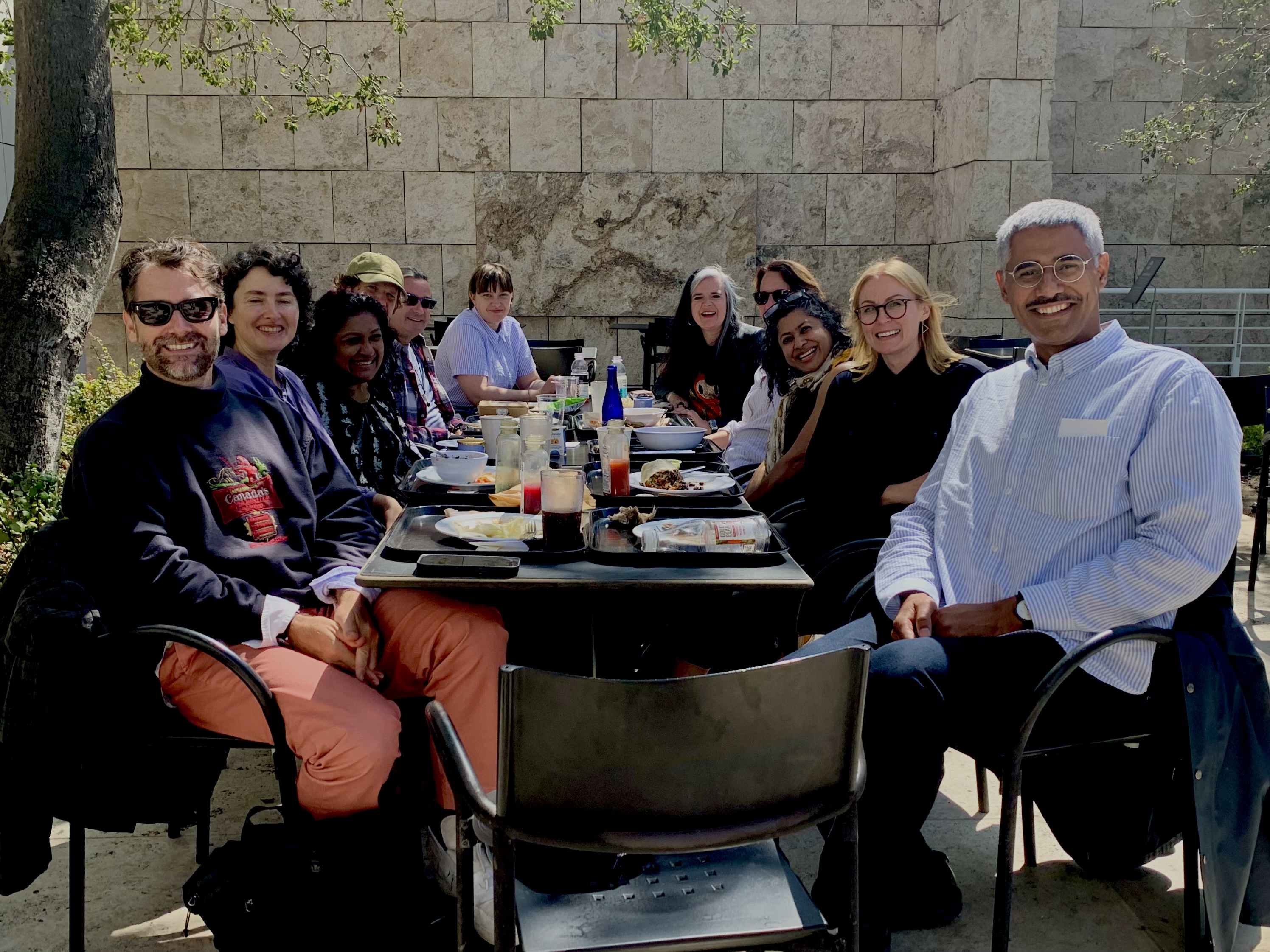
Hollyamber Kennedy at the Getty Research Institute, September 26, 2024, with fellow participants, from left, Manuel Shvartzberg-Carrió (UCSD), Juliana Maxim (USD), Anooradha Iyer Siddiqi (Barnard College/Columbia University), Rafico Ruiz (Canadian Center for Architecture), Sean Milanovich, S.E. Eisterer (Princeton University), Jill H. Casid (University of Wisconsin-Madison), Vittoria di Palma (USC), Vazira Fazila-Yacoobali Zamindar (Brown University), and Nitin Bathla (ETH Zurich).
This academic year was a busy one for Hollyamber Kennedy, in just her second year as a faculty member in the department. Following five weeks of archival research overseas in the summer months, Kennedy began the fall quarter with a three-day symposium, Settlement, at the Getty Research Institute in Los Angeles, which she co-organized with several research collaborators. Back at Northwestern, Kennedy had a meaningful teaching year that included two undergraduate lecture courses, one new to her roster, which brought in a handful of enthusiastic new majors and minors to the department. In late March, Kennedy participated in a roundtable at the Heyman Center for the Humanities at Columbia University with the Insurgent Domesticities Research Collective, of which Kennedy is a core member. The event was to celebrate their forthcoming peer-reviewed book of essays, Insurgent Domesticities (Columbia Books on Architecture and the City, 2026). This was followed by a public conference and workshop, Settlement Symposium, also held at Columbia University, co-organized by Kennedy and Anooradha Iyer Siddiqi, with whom Kennedy co-directs the Settlement Research Group, which includes Jill H. Casid, Nasser Abourahme, Nitin Bathla, Manuel Shvartzberg-Carrió, Rafico Ruiz, and Vazira Fazila-Yacoobali Zamindar. The group will reconvene at Dumbarton Oaks in Spring 2026 to finalize their book project, Settlement, before publication. Over the summer, Kennedy was hard at work on her manuscript, while preparing for a busy year ahead that includes several new courses and another year of the Kaplan Research Workshop, Art, Community & Environment, which she co-directs with Rebecca Zorach.
Christina Kiaer
Frances Hooper Professor in the Arts and Humanities and Department Chair
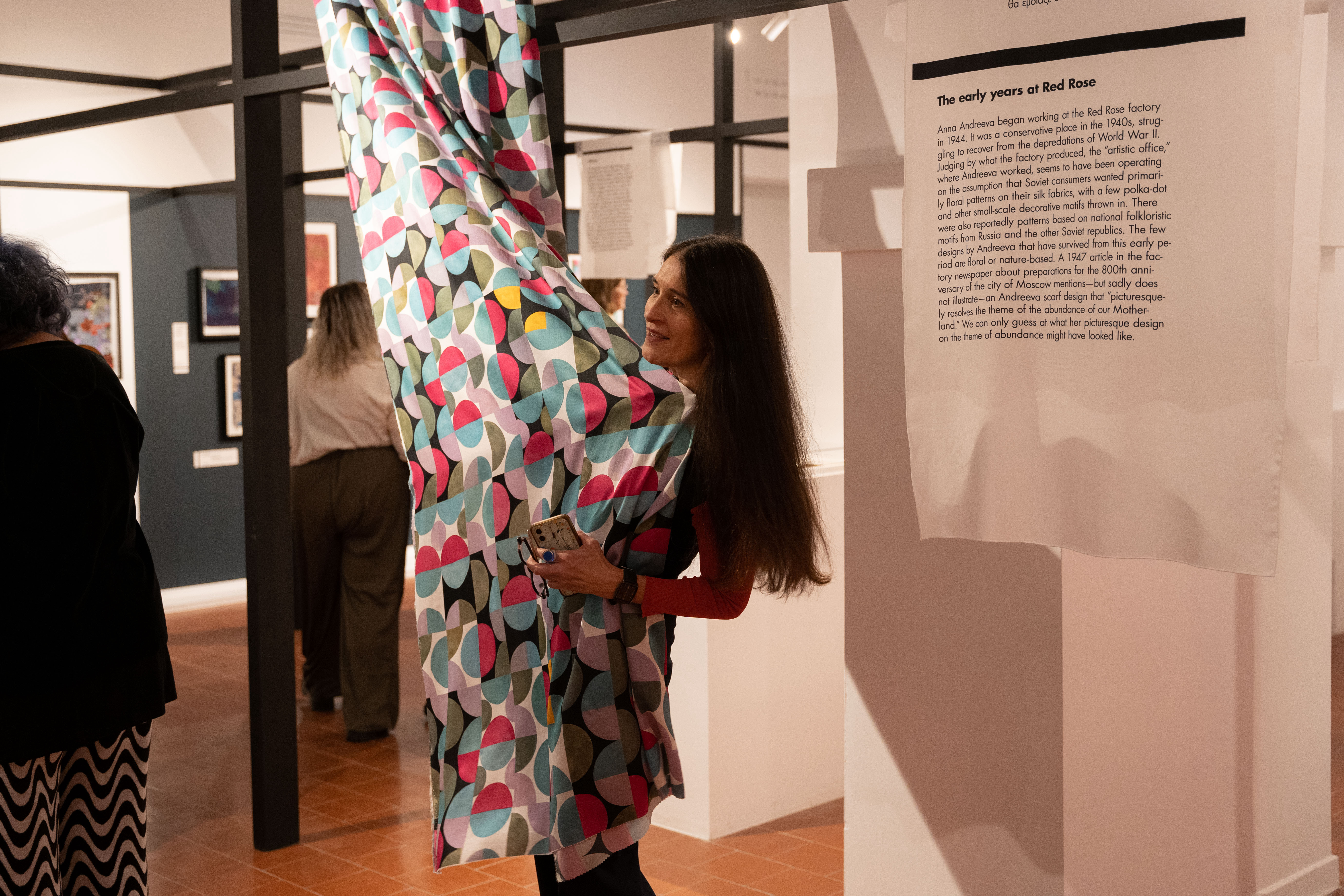
Christina Kiaer posing with a contemporary recreation of a fabric design by Soviet artist Anna Andreeva, at the press opening for Kiaer's exhibition “Collective Threads: Anna Andreeva at the Red Rose Silk Factory,” Museum of Modern Art-Costakis Collection, Thessaloniki, December 6, 2024.
Christina Kiaer curated the exhibition Collective Threads: Anna Andreeva at the Red Rose Silk Factory, which opened at the Museum of Modern Art-Costakis Collection in Thessaloniki, Greece on December 6, 2024, accompanied by an academic conference she organized on December 7. The exhibition showcased Andreeva’s designs, from geometric abstraction to state commissions commemorating events such as Yuri Gagarin’s first manned space flight in 1961. It documented the work of the all-female design collective at the Moscow factory, where Andreeva worked from the 1940s to the 1980s, and included contemporary silks printed from her designs for visitors to touch. Kiaer edited and wrote for the exhibition catalogue, which includes an essay by Ph.D. candidate Anna Dumont. In conjunction with this project, Kiaer developed a new undergraduate lecture course in Fall 2024, “Women and Textiles.” At a book event at the Sorbonne in Paris in March 2025, Kiaer presented the Collective Threads catalogue as well as her 2024 book Collective Body: Aleksandr Deineka at the Limit of Socialist Realism; happily, Ph.D. candidates Sasha Artamonova and Sarah Dwider were in attendance. Kiaer also presented Collective Body at book events at the University of California, Berkeley in October; the Seminary Coop in Chicago in November; Columbia University in April; and Northwestern, through the Russian, East European and Eurasian Studies, in May; a panel was devoted to the book at the Association for Slavic, East European and Eurasian Studies conference in Boston in November. At the College Art Association Annual Conference in New York, she presented a new paper, “Black Constructivism,” from her ongoing project on anti-racism in Soviet visual culture.
Christina Normore
Associate Professor of Art History and Director of Undergraduate Studies
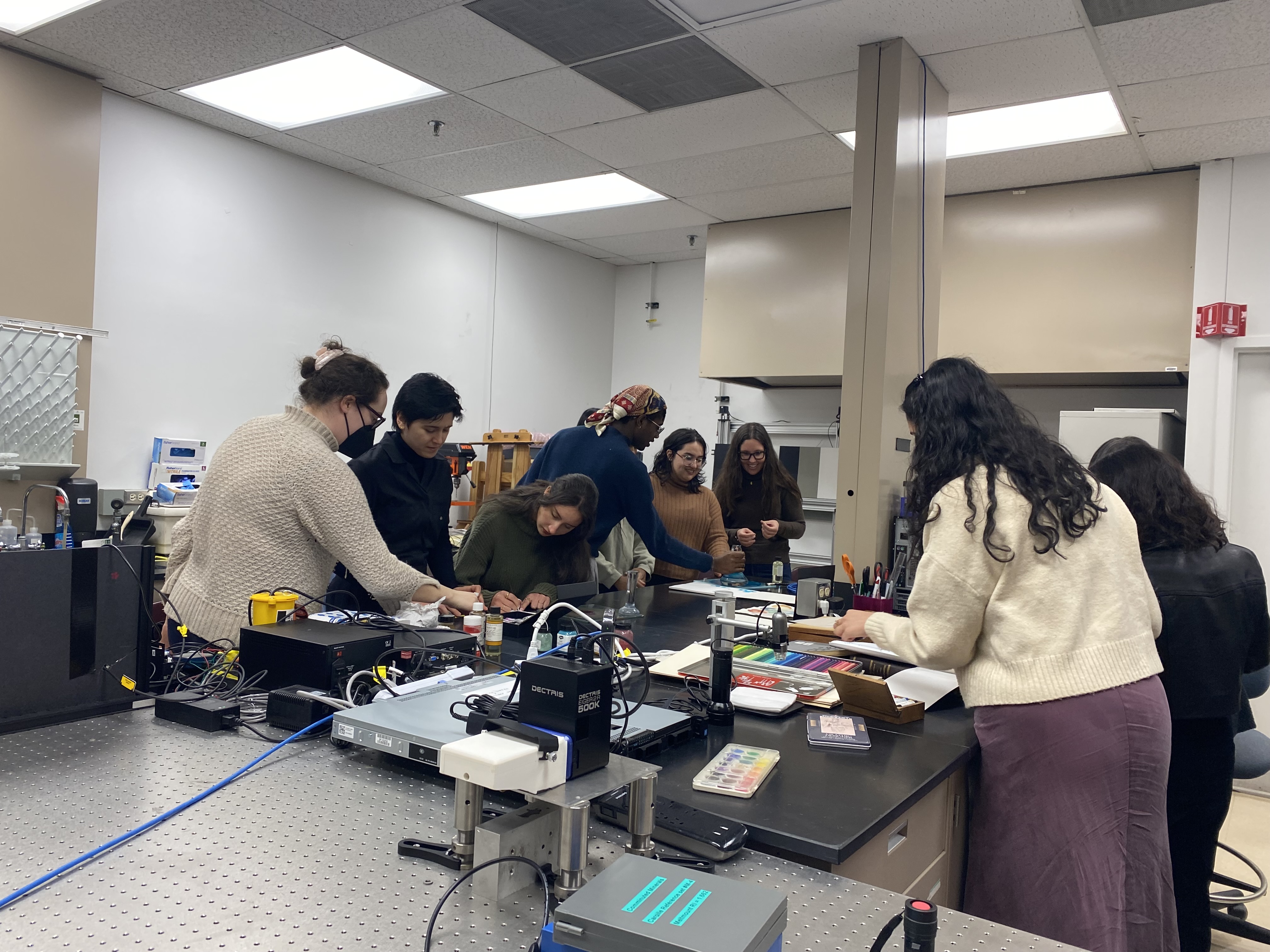
Graduate students from Northwestern and the University of Chicago experimenting with the production of pastels and oil paint in the NU-ACCESS lab during the winter 2025 COSI course. (photo: Maria Kokkori)
Christina Normore stepped back into her old role as Director of Undergraduate Studies this year while Jesús Escobar was on leave. With the aid of her committee (Antawan Byrd, Thadeus Dowad, and Ph.D. candidate Uche Okpa-Iroha) she helped the department successfully update both its major and minor requirements to better reflect current trends in the field and Northwestern University’s faculty. Outside of bureaucracy, she taught both survey and graduate level courses, including co-teaching (with Maria Kokkori and Andrei Pop) the first post-Mellon-funding iteration of the COSI course, which roamed between the University of Chicago, Northwestern and the Art Institute of Chicago. Her multi-year work with the AHRC-funded project “The Joust as Performance: Pas d’armes and Late Medieval Chivalry” finally came to an end in January with the publication of several contributions to the volume Pas d’armes and Late Medieval Chivalry, edited by Ros Brown-Grant and Mario Damen (Liverpool University Press, 2025).
Yuthika Sharma
Assistant Professor of Art History
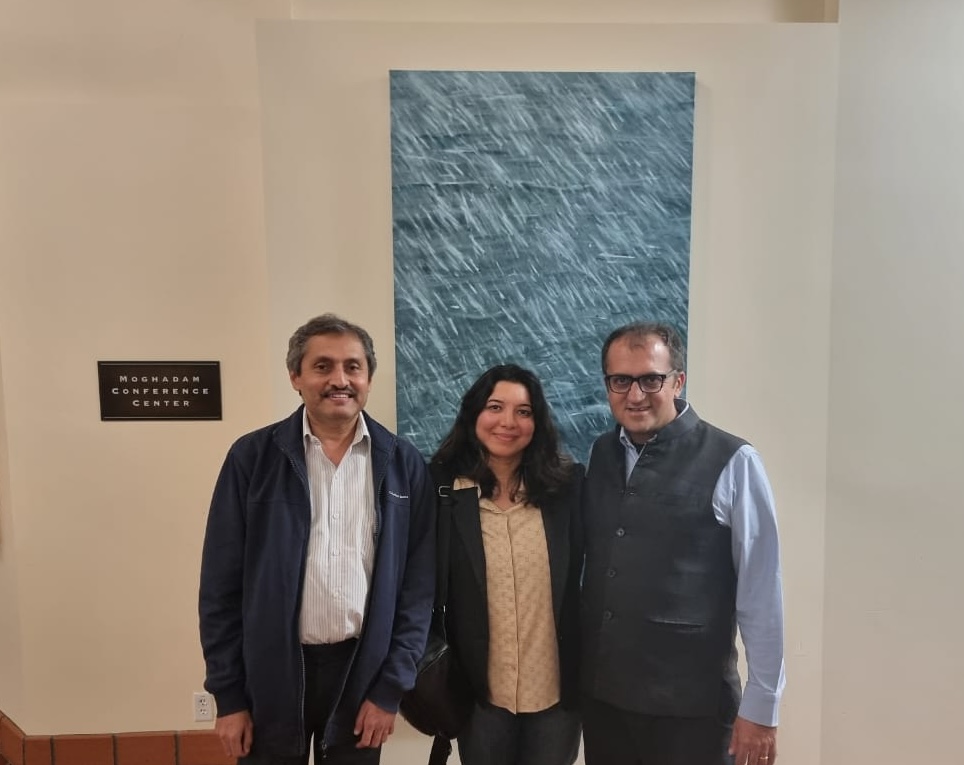
Sharma with Delhi filmmaker Yousuf Saeed (left) and conservation architect and director of projects for the Aga Khan Trust for Culture, Ratish Nanda (right) at the Center for South Asia, School of Global Studies, Stanford University.
Yuthika Sharma was based at the Center for South Asia at the School of Global Studies and was visiting faculty in the Department of Art and Art History at Stanford University, California, in 2024–25. Sharma worked on her book manuscript on the critical reformulation of Mughal and Company art in India's long 18th century. During the year, Sharma mentored two students, Vicky Wang and Elizabeth Lowry, recipients of the Buffet Undergraduate Research Fellowship. She supervised their work on a web resource on the travels of British painters Thomas Daniell and William Daniell’s within India between 1786-1793, which adds to a developing teaching resource linked to Northwestern Library’s collection of prints and published materials of South Asian landscapes. Earlier in winter quarter, Sharma presented a paper on colonial-era portraiture in India at the College Art Association Annual Conference, New York, and attended the business meeting of the American Council for Southern Asian Art as a newly elected board member. Over the course of the academic year, Sharma delivered talks at University of California, Berkeley; Stanford University; and University of California, Davis.
Krista Thompson
Mary Jane Crowe Professor of Art History
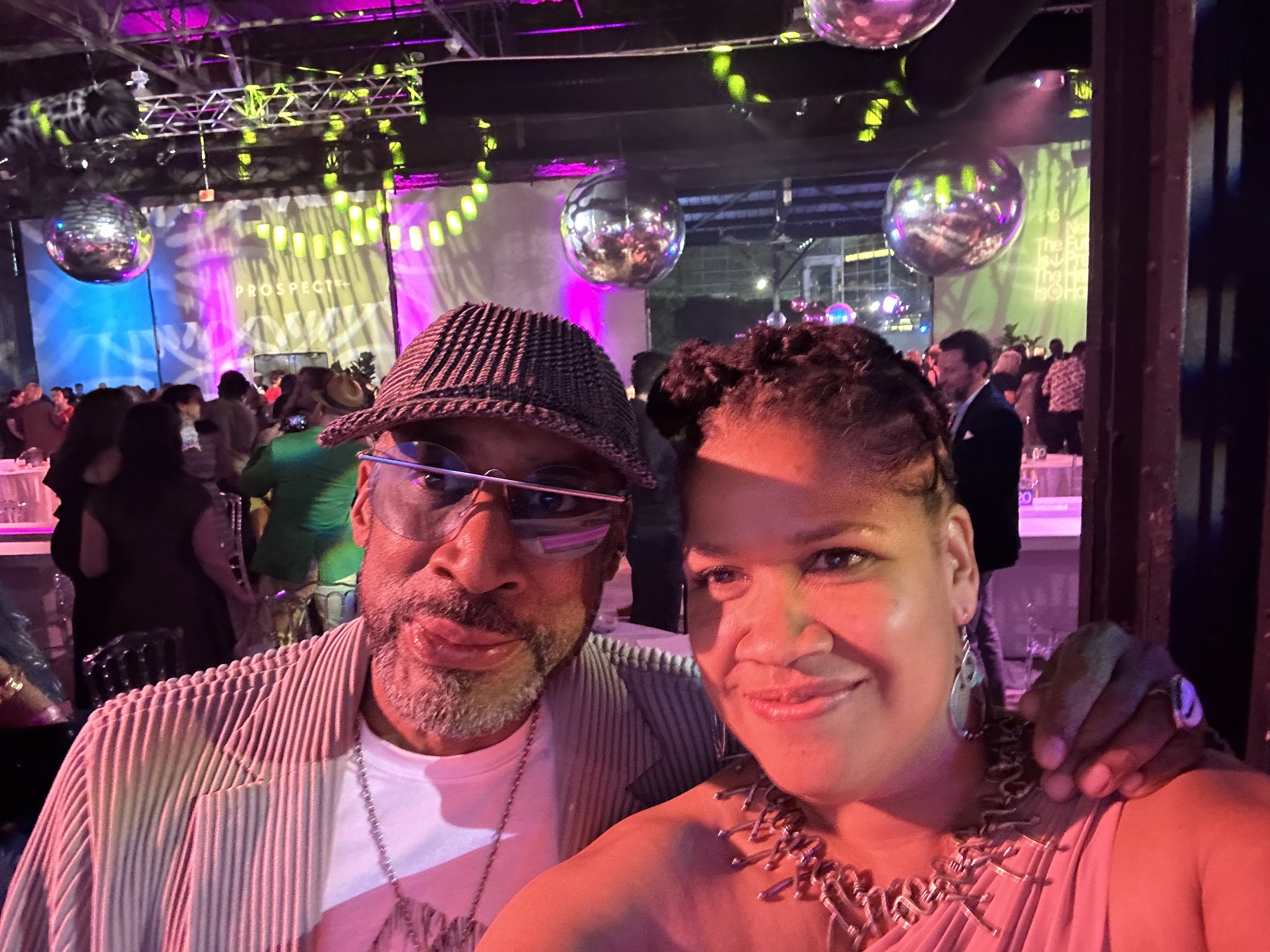
Krista Thompson and fellow honoree artist Nari Ward at the Prospect.6 Gala, New Orleans.
Thompson received a fellowship from the Guggenheim Foundation and was on leave for the academic year. During this period, she worked on the manuscript Refracting Light: Tom Lloyd and the Effect of Art Historical Disregard and wrote an essay for an exhibition on Lloyd opening at the Studio Museum in Harlem in Fall 2025. In October, Thompson was an honoree at Prospect.6, a prestigious contemporary art triennial that takes place across New Orleans. She participated in public conversations for Project a Black Planet: The Art and Culture of Panafrica at the Art Institute of Chicago and the Kingston Biennial at the National Gallery of Jamaica. The latter exhibition was inspired by Thompson’s book, An Eye for the Tropics (Duke University Press, 2005).
Rebecca Zorach
Mary Jane Crowe Professor of Art and Art History

Poster for Northwestern's April 17 Day of Action for Higher Ed
Rebecca Zorach embarked on her first year as Director of Graduate Studies and experienced the steep learning curve of supporting our graduate students in a very tumultuous and difficult year. She also worked all year with an ad hoc faculty group called The University Under Threat, and co-organized Northwestern's participation in the national April 17 Day of Action for Higher Ed. In June, she was elected President-Elect of the Faculty Senate (to serve in 2026-27 and as part of the Senate’s leadership as of September 1). Graduate teaching included a seminar at the Newberry Library focused on early modern print culture and the 2025 summer seminar (co-taught with Hollyamber Kennedy) traveling to Bologna, Italy. She also taught an undergraduate museums seminar which, among other site visits, engaged deeply with the exhibition she advised at the South Side Community Art Center, ReSOURCE: Art and Resourcefulness in Black Chicago. A catalogue accompanying ReSOURCE was published in Summer 2025. In the spring, she spent several weeks in Europe as a visiting researcher and member of two advisory boards for European research projects. In Oslo, she delivered the Lorentz Dietrichson lecture of the Norwegian Art Historical Association; in Paris, she gave the closing lecture of a summer school organized at the Institut National de l’Histoire de l’Art by the Analysis of Gold and its Uses as a Painting Material project on the artistic use of gold. She also completed a book entitled Spontaneous Objects: A Natural History of Art and its Others to be published by Penn State University Press in 2026.